Enough! Things pile up – the center doesn’t hold! If all this new visual and written work doesn’t get put out soon, the festering patina of time will seal, will bury everything.
The last post was, remarkably, in late July. How much has happened since then, seemingly with break-neck speed. Even as I write, things move faster and faster. I can’t possibly keep up. Paradoxically my own life seems to crawl at a snail’s pace, or stand suspended out of time entirely.
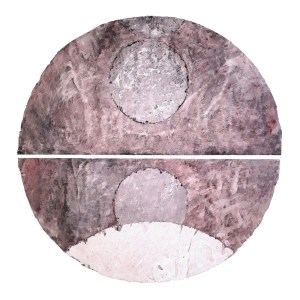
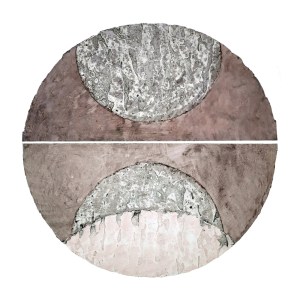
The Spherical Fragments, a brief return to collage for another MFT exhibition entitled PART>WHOLE / RÉSZ>EGÉSZ, were completed in one burst, sent to Budapest, the exhibition opening October 16th!
Aside from regular submersion in escalating horrific news reports (can it get any worse? – yes it does, yes it will!) I have been reading poems – more Bertolt Brecht, now Octavio Paz, returning to József Attila to find poems somehow overlooked, revisiting W.B. Yeats. Passing as needed through the tortuous, exquisite route of translation by brilliant poets and writers, these words offer courage and co-conspiracy. Bridging decades, generations, centuries, they are antidotes to isolation and despair. Locked in solitary conversation with these great voices from the past, I continue to put down my own words, which can be seen here.
Ending now with Octavio Paz and József Attila . Very different, yet both speaking of what needs to be said. Next time, Brecht’s What use isgoodness?, Paz, J.A. and some Yeats.
– Diane Sophrin Vermont (10.4.20)
CERTAINTY
If it is real the white light from this lamp, real the writing hand, are they real, the eyes looking at what I write?
From one word to the other what I say vanishes. I know that I am alive between two parentheses.
Octavio Paz Salamandra – Salamander [1958-1961] English translation by Charles Tomlinson
The Poems of Octavio Paz Edited and translated by Eliot Weinberger A New Directions Book. 2018
On the pavement a small puddle was blinking
as shadows began to occupy the streets.
In their restless dreams sparrows were chirping
but then silently hung on to their twigs.
The sleeping ones will always cling
harder than the awake, ready to take flight.
People, streetcars, taxis were bustling
just like the instincts and the mind.
I kissed a girl on her mouth in a doorway, then I mixed in among the crowd again, Only to separate from it once more, so that this poem could crystalize from life’s pain. At last I see, after long meditation, my animal sorrow is understandable human grief that finds its scintillation even in advertising displays.
Attila József 1935
Winter Night. Selected Poems by Attila József translated from the Hungarian by John Bátki Oberlin College Press. 1997
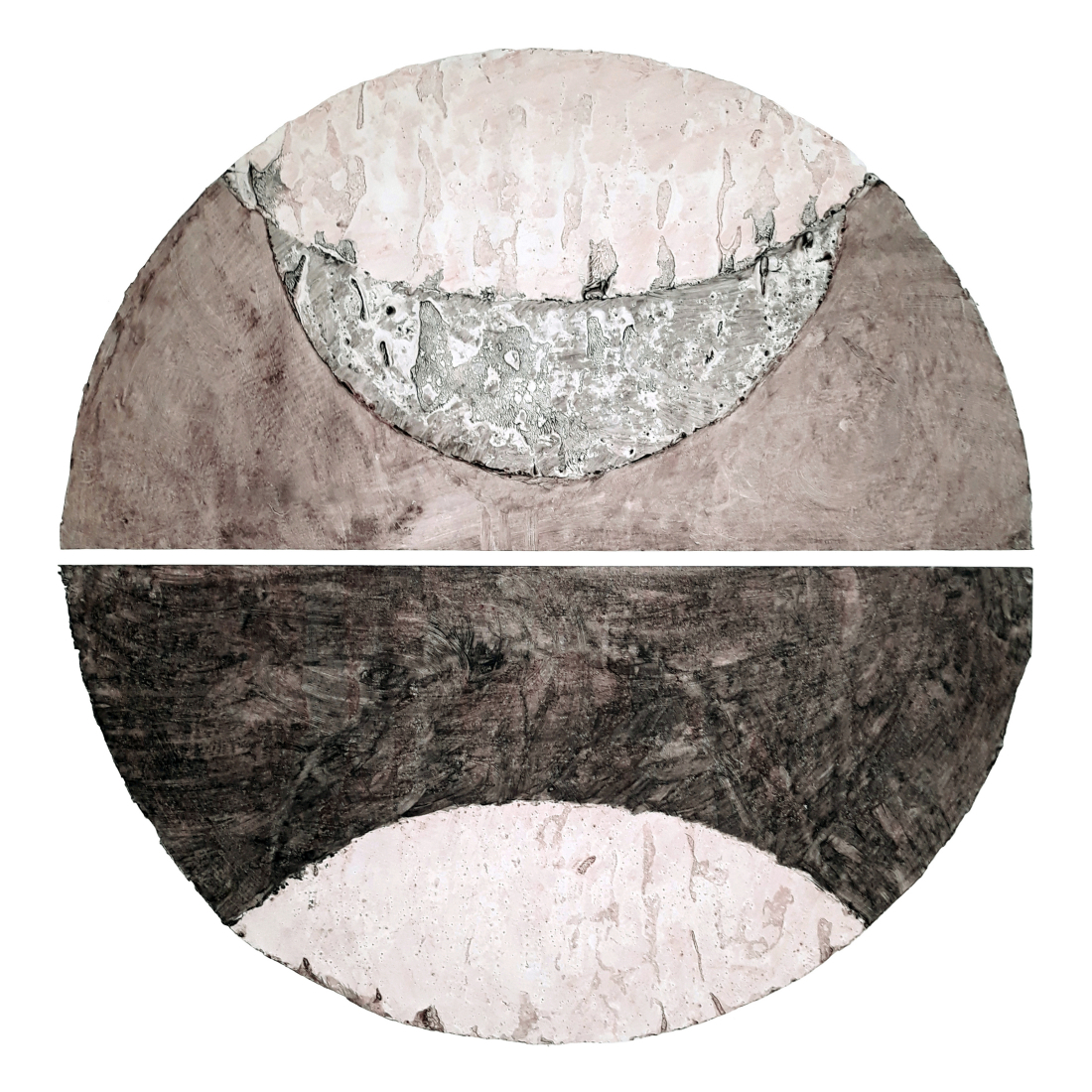
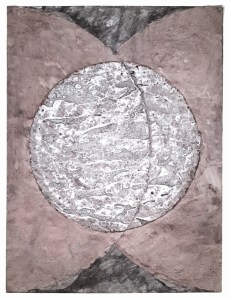
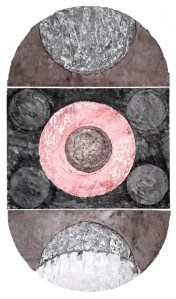
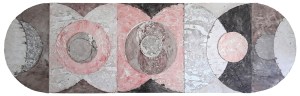
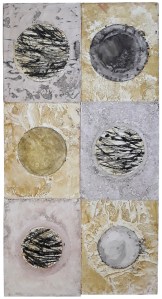
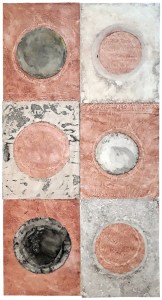
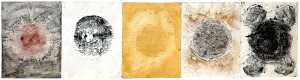
This new, ongoing body of work, Spheres of Destiny & Variants follows along the same parameters as the other recent double-sided assemblages; the Swingeing Spots, Big Looming Assemblages, Spots of Retribution and Dark Spots & Black Holes. Why this persists I am not sure! It offers itself, it suggests, or with stronger imperative, demands. I oblige. Click on any image for larger images of each group seen sequentially: first, the Spheres of Destiny and below them, the Variants:
The configuration/reconfiguration of the assemblages comes next, along with the photographic documentation. This aspect of the work is maddening. The impulse to track, know and document these groupings is compelling, unforgiving. Perhaps the final manifestation must wait for exhibition, when the pieces will naturally suggest, demand and determine specific assemblages – or perhaps not even then!
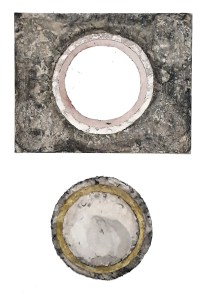
At this point in time, one double-sided diptych Spheres of Destiny I and II has made its way to Budapest in my stead, currently exhibited in the HORIZONTjuried exhibition of the Society of Hungarian Painters (Magyar Festők Társasága). In fact it was the exhibition theme which led to this format of spherical paper diptych with central horizontal gap.
Here in Vermont, the work on this series is ongoing – both in terms of continued grouping and documentation of new assemblages, and the making of more new pieces. The newest, still in their early stages of formation, are large, boulder-like, sisyphean.
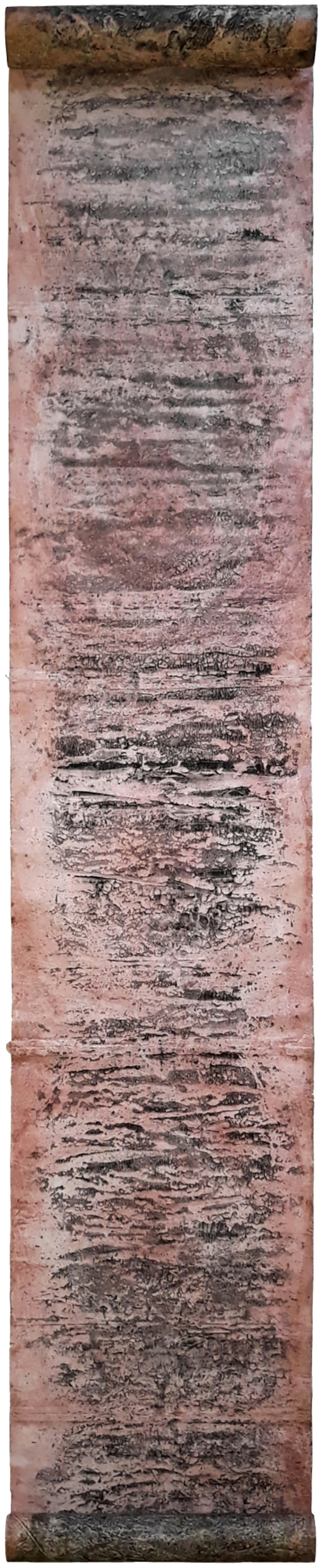
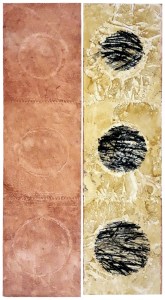
The work with spherical forms continues – in this case a pause from engagement with movable parts offering a return to long, vertical scroll-like panels. Again the work is double-sided, especially relevant to the scrolling functionality of this piece.
This long single paper panel was stitched together and gessoed several years back, while working on four-panel acrylic paintings. At the time I was particularly interested in the stitching methods used in Torah scrolls which minimized the visibility of stitches themselves. Unused and waiting, the prepared, empty scroll now presented a perfect surface for continuing the work with Spots and Spheres.
Presenting itself as a piece to possibly be viewed flat – read in an act of scrolling and unscrolling, the work process continued as before. Two small wetted pages blackened with dense chalk spheres were repeatedly pressed into the acrylic-stained scroll, transferring the black forms in a rough offset process. The scroll was then rolled up and the motion and pressure of rolling created a somewhat linear-reading sequence of marks and forms. These two images are front and verso of the one 67 inch scroll.
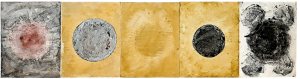
And here, the two water-soaked small pages with black chalk circles – remnants of the work process, but visually suggestive elements in themselves.
What good do they do
these colors
these circles
like the sun an eclipse that’s it!
eclipsing all that is right and good
leaving just the ghost of a black hole don’t look straight at it!
the truth will scorch
your eyes
delight
in the papers
stained and puckered
lovingly
what to do with the eye’s delight
when the heart bleeds.
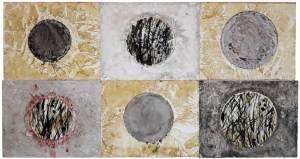
What are these circles and why do I keep doing them? They began in 2019 with the Black Spots of Winter and I have been working with black circles, spots and holes ever since. These Swingeing Spots, are the latest. As with the Dark Spots and Black Holes, Spots of Retribution and Big Looming Assemblages, these newest two-sided pieces are arranged, layered and photographed, creating what are for now, impermanent groupings.
Click on any image below for larger images seen sequentially.
Am I taking the easy way out by continuing to follow this thread? I do see the obvious referencing of natural structure, reflecting an ailing nature. Now we are at one with nature. But is that enough?
The form and content begin with a simple attraction of the eye. It’s the eye that guides now, not arbitrary yet not consciously meaningful. Is it just automatic form-making? I don’t really need to know this. The point is that I have neither used up these forms nor this particular media, although under different circumstances other forms, other media could do the job equally well. Not arbitrariness but fluency?
But why this apparent invisibility of the hand? There is no brushwork, little gestural mark-making. The application of color and tone, the creation of texture are all created by basic printing processes – offset, relief, stencil, transfer. Is this legitimate? Why not? The essence of a print being pressure rather than duplication (although that sometimes occurs), in this case simple pressure of the hand itself is where manual expression comes into play, the physical assertion of a human hand at work. I am satisfied.
















 Diane Sophrin