
THE SHORT TAKE: Work has resumed. Spring and summer were full – of big decisions, of big shifts and much hard work. Autumn emerges from a prolonged and turbulent summer, cycling into sharp, brilliant days as I find myself in a new studio in a new home in a new city.
A new series suggests itself unbeckoned; as I opened box after box of art supplies carefully wrapped in twisted, torn, crumpled pieces of brown paper, the packing material accumulates in piles, presenting itself as – what else? – raw and exciting collage material!
A piece had to be submitted to the Front Gallery for the October members’ group exhibit and with all my works still ensconced in storage, the need to make something new arose. Raw material at hand and a studio space set up, work began naturally. Surprisingly yet unsurprisingly, this fresh work follows new impulses yet echos and connects to pieces done years ago. It’s great to pick up all the threads and get to work!
The Long Read follows below images.
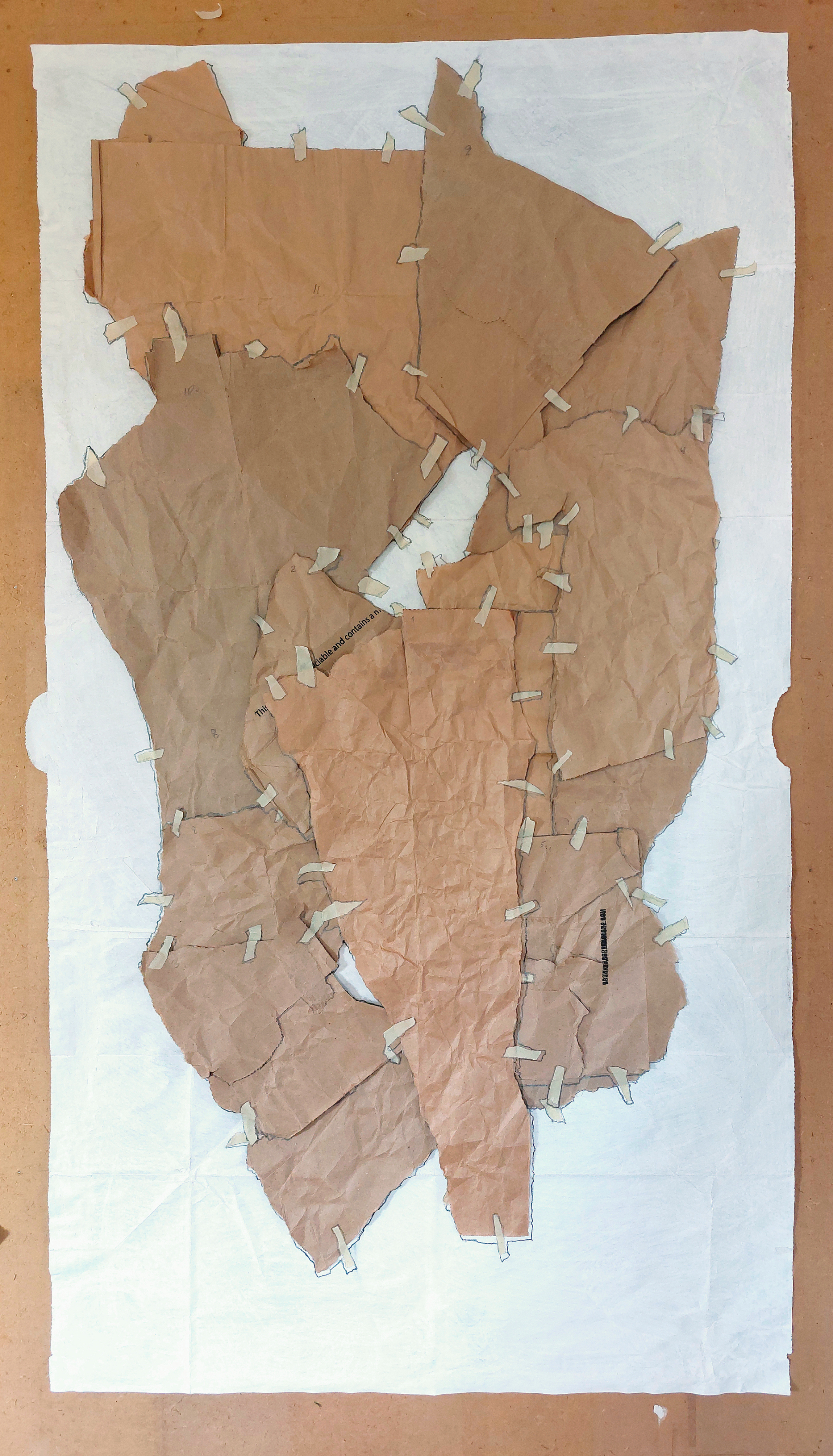

THE LONG READ: More decisions lay behind each step of the creative process than imaginable looking at this first finished piece.
The initial stage was led by the impulse to analyze, identify and define disconnected components of a temporary (collaged) whole. Collage as allegory has been explored in my work before, in the 2020 “World as Collage” series.
As this newest piece developed, a duality of identity emerged from the work experience: was the focus that of concept of process or completion of a whole – act vs form. While this duality coexisting within the creative process isn’t so unusual, the end presentation demanded a choice. Which way to go? In the end I went with presentation of the whole, letting photographic documentation keep the concept of fragment alive.
Additionally, the completed whole form is two-sided (been there before!) but in this case, as the piece would be mounted to a free-hanging, flat-toned rectangular paper bag, spot-gluing the collaged form to the paper was chosen. Again, photographing the verso before mounting it to the paper documents what is no longer visible.
Then there were the numerous tape tabs- what was their identity and purpose? Glazed with acrylic gel as was the entire piece, they ceased to serve their initial role of adhering form to background sheet. The tabs, still attached to the form on one end, curled and hung freely at the other end. What to do? Leave these appendages as interesting but purposeless visual elements or reassert their role as “fixers”? This was a crucial question, since the very idea of fragmentation and repair was inherent to the work.
In the end, it’s mostly the now glued-down tape tabs that hold the fragments in place, implying the temporal nature of a whole created from many parts. And that’s the point, conceptually. Visually, the figural form stands stark against the light background, a dark and mute testimony to the 21st century.
– Diane Sophrin
Burlington (10.10.24)
 Diane Sophrin